
Time for a little-known piece of trivia: did you know that the classic 1979 anime film Galaxy Express 999 had a sequel? I didn’t, either. Alas, this seems to be the fate that many sequels share, especially those of classic anime. Seriously, how many people do you think know about the existence Eureka Seven AO or Ghost in the Shell: Innocence? Sadly, many sequels, whether or not they’re done in TV, movie, manga etc. form, are more often than not, forgotten about. However, whether or not they’re actually good, satisfactory, manage to tie up a story or present a newer one (while still keeping similar elements as the previous incarnation) is an entirely different ball game. When I discovered that there was a sequel to GE999, I found almost no reviews online, so I decided to take matters into my own hands and watched the film in its entirety. Thank me later. Maybe this’ll show up on Google one day. Let me know if it does.
But I digress. The plot of Adieu Galaxy Express 999 (also known as Adieu Galaxy Express 999: Final Station Andromeda) goes as follows: Set two years after the events of the first film, our main protagonist, Tetsuro Hoshino, now a bit older, has joined an Earth resistance fighting against the Machine People, led by Queen Promethium, who is still a fearsome entity despite having lost her physical form in the previous film. He has abandoned all hope of ever seeing his beloved Maetel or the Galaxy Express 999 itself ever again.. until he receives an automated message from Maetel, urging him to rejoin her on the 999 for an unknown reason. When he does, she is nowhere to be seen, and the train starts behaving erratically, moving on its own course. Tetsuro, once again, must embark on a journey away from his venerated Earth, to distant planets, all the while dealing with vicious enemies and meeting up with fellow allies, both new and old. And this time, he vows to find Maetel, defeat Queen Promethium, and end this conflict once and for all.

Here’s my main case for this sequel: it’s a great film, but it’s also a terrible film. I’ll explain by listing what I enjoyed about it. First of all, the animation was simply stunning; director Rintaro (who also directed the first GE999 film and the 1978 Captain Harlock TV series) was certainly no slouch in that department. He made full use of his visual creativity and his position as director, making almost every sequence in the movie into an arthouse moment, which I’m sure must’ve blown people away in 1981, considering it still looks good even now. In many ways, the animation is much better than its predecessor, and visually, its much better than the original. That screencap I put up there won’t do it justice. In addition, many of the questions that are posed in the first movie are wrapped up, albeit a bit hastily.
However, this is where my praise must unfortunately stop, because almost everything else in the movie is… not good. You see, although it was marketed as the conclusion to the Galaxy Express series, neither the manga nor the TV adaptation would actually be concluded until a few months later. Not to spoil anything, but after watching it all the way through, the notion that even the film itself tried to make the ending seem like it had all the gravity of being the legit ending of the sci-fi story is very odd, considering it was nothing of the sort for the majority of its 2 hour runtime. This brings me to my next, slightly exaggerated issue: nothing happens. Yes, many of the questions were wrapped up (as mentioned above), but besides that, pretty much nothing of narrative importance occurs. The first film had the narrative of Tetsuro on a quest for vengeance against the Machine People for killing his mom, while at the same time learning about what it means to be human by learning about and growing closer to Maetel, Captain Harlock, Tochiro, and others, the narrative for this one is… the 999 is somehow going off-course and nobody knows where it’s going, and Tetsuro wanting to find Maetel again because, well, she told him to come.
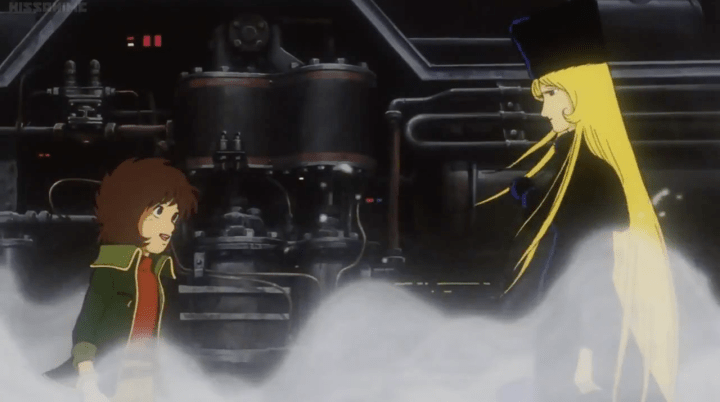
Remember those impressive animation sequences I mentioned earlier? Although they are gorgeous from an art perspective, they are, 90% of the time, placed in a scene where nothing of emotional importance happens. The first movie very much rode off of the emotions of the characters while at the same time having an over-arching narrative, and there, Rintaro’s artfully-crafted sequences worked a lot better, since there was actually something the viewers could experience and relate to happening in the scene, whether it be sadness, happiness, anger, etc. Here, although all of the characters from the previous film were present, nothing is done with them emotionally (or narratively for that matter), therefore all those artsy scenes, which were meant to make the audience feel something, lose all their intended emotional value.
In conclusion, Adieu Galaxy Express 999 is not a film with no redeeming qualities, In fact, I’d personally say it’s a bit hard to dislike it simply because of how wonderful and artistic it looks. But if you’re considering watching this, watch it for the visuals alone, otherwise you’ll be disappointed. You’re probably better off watching the first film instead.
Final score: 5/10
 The Art Archive