
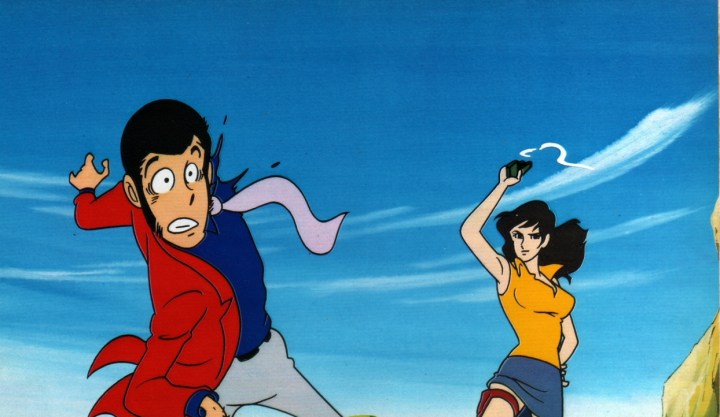
Welcome back! In the previous Retro Retrospective, I went over the basic premise of Lupin III and introduced the core cast. Now that you’ve had a chance to get to know them better, let’s get right into it. Remember, the names of all the adaptations (as well as important names associated with the franchise) will either be in bold or in italics.
The first installment of Lupin III was, of course, in manga form. The series was the brainchild of Japanese manga artist Kazuhiko Katō (under the pen name Monkey Punch), who became inspired after reading 15 of Maurice Leblanc’s stories, many of which featured Leblanc’s fictional French master thief… Arsène Lupin. According to him, the aim of the series was “to produce a comedy adventure series that reflected the traits of Leblanc’s character”. In addition, he was also inspired by the likes of Agatha Christie novels, James Bond, The Three Musketeers, and the films of Alfred Hitchcock. The Lupin III manga began serialization in the Weekly Manga Action magazine starting August 10, 1967. Originally, the series was expected to last only three months, but due to its popularity, it reached up to a staggering 14 volumes (94 chapters), eventually ending on May 22, 1969.
At this time, anime producers were taking note of Lupin III’s success, and wondered if it could possibly gain more popularity as an animated TV show. Thus, the Lupin III pilot film was created in 1969. The 12-minute short film of sorts, directed by Masaaki Osumi, was the first animated adaptation of the series, and was intended to garner interest from the public and secure funding. One notable aspect of this pilot film is that it was shot and recorded twice, meaning it had two different voice casts, one for the CinemaScope pilot, one for the TV pilot. Also notable is that only two of the voice actors were retained for both pilots – Kiyoshi Kobayashi (as Jigen) and Eiko Masuyama (as Fujiko).
Eventually, the first TV adaptation began airing on YTV in the fall of 1971 – Lupin III Part 1, otherwise known amongst fans as Lupin III: Green Jacket, for obvious reasons. It was broadcast for 23 episodes, the last one ending on March 23, 1972. At first, it was directed by Masaaki Osumi (director of the pilot), but he was later replaced by then-newcomers Hayao Miyazaki and Isao Takahata. Sound familiar? Keep those names in mind!
Here comes the money! It didn’t take long for the actual film industry to catch up to Lupin, either. Lupin III: Strange Psychokinetic Energy, released in the summer of 1974, was both the first theatrical and first live-action film of the series. In contrast to the darker themes of Green Jacket, this film was very heavy on the slapstick comedy, insane gravity-defying stunts, and general wackiness. Strangely enough, it included all five cast members… except Goemon. Perhaps he was just too serious for something as kooky as this?
Goemon would not be absent in the next adaptation, however. Lupin III Part 2, also known as Lupin III: Red Jacket, began airing on NTV in the fall of 1977. The longest-running TV adaptation by far, Red Jacket ran for 155 episodes before ending on October 6, 1980. Red Jacket is one of the more well-known Lupin adaptations, thanks to it being shown on [adult swim] in the US before Green Jacket. In comparison to its predecessor, Red Jacket was a lot more comedy-oriented. In addition, it created and cemented the most famous Japanese voice cast arrangement for the series: Yasuo Yamada as Lupin, Kiyoshi Kobayashi as Jigen, Makio Inoue as Goemon, Eiko Masuyama as Fujiko, and Goro Naya as Zenigata. With one exception, this lineup would remain unchanged for the next 18 years.
While Red Jacket was still airing, two feature animated films were released, one of which would become a beloved classic as the years went by. The first of these films was Lupin III: The Secret of Mamo (also known as Lupin vs. The Clone), released on December 16, 1978. Besides it being the first animated theatrical adaptation, the only other aspect of note is that it is very much science-fiction based. Cashing in on Star Wars, perhaps?
Nevertheless, it was the second of these movies which would prove to be the most well-known amongst anime fans, and this movie was Lupin III: The Castle of Cagliostro, released the following year. It was directed by none other than Hayao Miyazaki, who went on to form the acclaimed Studio Ghibli with Isao Takahata a few years later. While the two had worked on Green Jacket, as well as two episodes of Red Jacket (to be specific, these were episodes 145 and 155), this was the first time Miyazaki would be handed a directing job. While it wasn’t initially considered a box-office success, its charming style and fun animated action sequences, coupled with numerous re-releases, made it incredibly popular amongst people who weren’t even fans of the series!

That’s all for now, folks! Tune in next time, where I’ll hopefully go over the next Lupin series, in which he wears a very different jacket… place your bets now!
 The Art Archive