
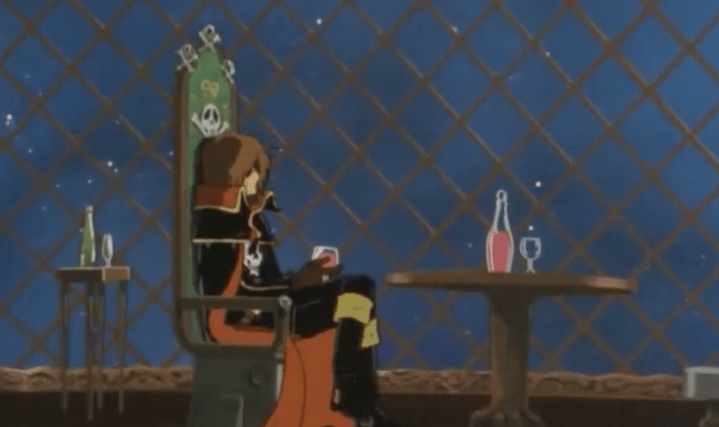
Oh boy, here we go again. You might remember that, around 6 months ago, I wrote a review on the 2013 Captain Harlock film, and most of it was filled with praise. Fast-forward to this summer, where I spent quite a bit of time re-watching other Harlock media. After that, I watched the 2013 film again, and this time I began rethinking my opinions on it, and came to a very different conclusion: Harlock 2013… is not good. And here’s why. Spoilers abound, of course. I’ll try to explain things in as much detail as I can, but if you want the bigger picture, watch the film first and come back to this. Also, I didn’t bother getting screencaps from it, so every cap in this analysis is from the ’84 TV show Endless Orbit SSX, just so you know. Anyhow, let’s get into it.
PART 1: PRELUDE
Before I really start this off, there’s probably a few of you wondering if there’s anything I actually liked about this film. Well, yes. I praised the animation and cinematography, which is entirely made up of CGI and motion-capture, and I’ll still praise it. It looks fantastic for an all-CG film, and the characters are still visually recognizable, even if you’re an older fan of the franchise. Something else I feel that I should mention is that, on my second watch, I watched the English dub of the film. Now, I didn’t exactly have the highest expectations for it, considering that almost all dubbed Harlock properties are okay-ish at best and bad at worst. Thankfully, dubbed Harlock has been getting better over time, with Cosmo Warrior Zero (released in 2001) and Endless Odyssey (released in 2002) both receiving pretty good dubs (Zero in particular), and luckily this film was no exception. Sure, it’s not the perfect dub (case in point: several characters get their names changed for no reason and the writers can’t seem to decide what to call the Gaia Sanction), but all the voice actors did their job just fine and none of the characters sound off, so overall it’s a generally favorable dub. So, to recap: the visuals and the dub are satisfactory. Now, let’s get into the not-so-great stuff.
PART 2: A STUDY IN CHARACTER ASSASSINATION
(HARLOCK EDITION)
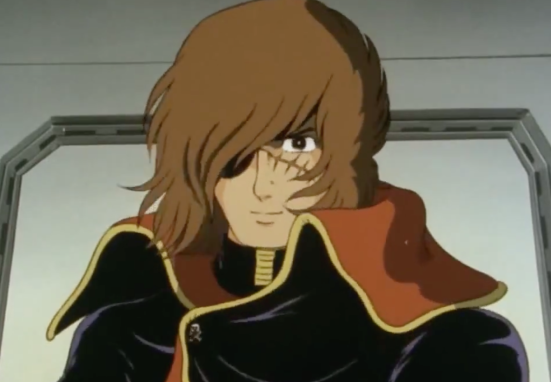
It’s safe to say that Captain Harlock as a franchise has changed over the years. With every iteration of the series, there’s always new characters, new stories, and new experiences. However, there has always remained one constant: the space pirate himself. So, let’s quickly go over Harlock, what makes him human, and what makes him a great character.
To put it simply, Harlock is a rebel-turned-space pirate captain who, alongside his like-minded crew, fight for freedom and independence of Earth from the Illumidas, a race of aliens who want to take over Earth and the rest of the galaxy. He also maintains a valuable relationship with Tochiro Ooyama, his best friend, a computer engineering prodigy who designed his ship, the Arcadia. He allows anyone onto his ship, as long as they fight for their own wishes, and desires, and he never makes them have to share their reasons for wanting freedom to anyone else. Even though he’s viewed as an outlaw and a traitor by the Illumidas and the corrupt Earth government, Harlock will always put himself and his ship in between his home and any outside threat, no matter how dangerous it is. In addition, he has a strong code of honor, free will and self-control, which includes an aversion to taking human life. For example, in EE SSX‘s final battle between Harlock and Dr. Zone (the overarching villain), Harlock refuses to kill him despite Zone begging him to. Why? In his own words: “because you and I are both of Earth”. In fact, it took very serious circumstances for him to even consider such a course of action. Despite how poor the state of Earth is in every series, Harlock never gives up hope that Earth can change, no matter the odds, and he and his crew will do whatever it takes to restore peace to the place they call home.
 (Harlock and the aforementioned Tochiro)
I hope you remembered all those important character traits, because they all take a very heavy blow in 2013 Harlock. At this point, I’ve got to mention something: this isn’t the first time an attempt at a darker and more threatening Harlock has been made. The 2003 Endless Odyssey had Harlock be a more stoic (almost to the point of self-parody) man who had no problem killing humans, but other than that, he was still mostly the same person. However, the best I can say about him in this film is that he’s recognizable from a purely visual standpoint, and, in all other respects, he’s about as far from the original character as you can get.
In this adaptation, Harlock isn’t fighting an alien race – instead, he’s pitted against the all-human Gaia Sanction, a powerful authoritarian government who, like the Illumidas, want to control Earth and are secretly hiding the true state of Earth, which has really become a barren wasteland, from everyone. By pitting Harlock against an all-human enemy, the aspects of his code of honor and self-control are completely thrown out of the window. Likewise, his entire demeanor has changed as well. Sure, Harlock’s attitude has been subject to change, i.e the goofier Harlock seen in Zero, but this time, he’s like the Harlock in Endless Odyssey, only 10 times more stoic, and is rarely ever seen interacting with any of the members of his crew, aside from giving them orders when in battle and the occasional conversations with Yama, the protagonist. Also, remember how I said Harlock would accept anyone onto his ship on the condition that they fight for what they personally believe in? Yeah, no. Within the first few minutes of this film, you see Harlock’s crew send a few men who wanted to enter the ship plummeting to their deaths (it’s okay, they survive somehow) because they didn’t give the crew the ‘correct’ answer for wanting to join them. Something else occurred to me upon rewatch, and that was how little screen time he actually has. In short: I’m pretty sure Jar Jar Binks had more screen time in all three of the Star Wars prequels than Captain Harlock did in a film called, y’know, Captain Harlock. This, in turn, means that Harlock has no real character arc or development, which, in every other adaptation of anything from the Leijiverse, he would get, no matter how big or small his role in them are. Case in point: in Adieu Galaxy Express 999, where Harlock is merely a cameo role, he learns that, in the end, sometimes he can’t save everyone, and he grows more supportive of Tetsuro (the main character) as the story goes on.
But I haven’t gotten to the worst part of his character yet. If that were it, I could argue that he’s still fighting for a noble goal, which is bringing freedom back to Earth, even if he’s got just about as much personality and charisma as a soggy paper towel. However, the filmmakers decided to take a darker approach here too, and it ended up being the worst decision ever made. Take a sip, because this is going to be a bit hard to digest. So, almost around the halfway point, we the viewers learn the biggest plot revelation by far: Harlock himself was the man who inadvertently destroyed Earth using Dark Matter. This comes as a shock to the whole crew, but it turns out that there’s another twist – that Harlock’s cure for all this is worse than the disease. It turns out that, after years of outright lying to his crew that they were going to find a way to reverse time to save Earth, his real plan is to create a black hole using Dark Matter, which will – wait for it – destroy the entire universe, which in turn will trigger another Big Bang, and thus the universe will eventually be reborn. Furthermore, this occurs around the hour mark (like I previously mentioned), and, combined with his scant screen time thus far, new viewers are going to feel very confused, since they barely know him enough to agree with him or want to see him succeed. With this revelation, the Harlock who always believed in hope and would protect Earth with his life is gone, and is replaced with a borderline psychopath. Moreover, the aforementioned Dark Matter incident, like a superhero origin story, gave Harlock the power to accomplish nearly impossible feats and made him immortal. Now I can truly say that 2013 Harlock isn’t even human anymore. He just isn’t, and it’s honestly saddening.
PART 3: A STUDY IN CHARACTER ASSASSINATION
(EVERYONE ELSE EDITION)
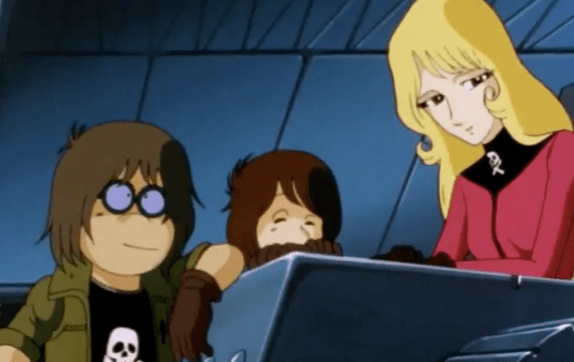
(Just a small part of Harlock’s crew! From left to right: Tochiro, Tadashi, and Kei Yuki)
Although Harlock is the title character and face of the franchise, Harlock wouldn’t have been half as interesting without his ragtag crew onboard the Arcadia, who are all unique, have their own goals, and have good reasons to be loyal towards their captain. These characters, besides being fundamental parts of Harlock’s quest, also have their own character arcs, and they learn as much from Harlock as Harlock learns from them. Alas, these characters were not spared from this adaptation either. I’ll try not to go into too much detail, seeing as this whole thing is already quite long, but I’ll try to get my point across as much as I can.
First up is La Mime, the last-of-her-kind, harp-playing, alien woman who serves as Harlock’s assistant and one of his closest friends, and who is usually the first to warn the crew of any danger. Although her look here has completely changed, opting for a more green color palette and a pirate uniform instead of her usual alien garb, she’s one of the few more familiar faces in this film. However, she doesn’t exactly have much character, and I could just describe here using one word: “ethereal”. Her role isn’t exactly touched upon, and her relationship with Harlock is barely alluded to. Moving on…
Next is Kei Yuki, the naïve young bridge officer and lieutenant with a passion for science who fights for freedom on behalf of her dead father, who was killed by the Illumidas. In this film, she’s your typical “strong female heroine” who can fire two guns at the same time, has the attitude of a drill sergeant, and, instead of having a solid moral compass, is hopelessly loyal to Harlock, even after finding out about his true plan. Also, fanservice. Seriously, was that zero-gravity shower scene necessary?
Last but certainly least is first mate Yattaran (whose name is changed to Logan in the dub), the socially awkward and introverted man who nonetheless has a great aptitude for physics and a love of building models of ships and airplanes. Like Kei, his character is changed to the typical “boisterous, annoying, and sarcastic nerdy guy” fare. Nothing much to say here.
Special mention must go to Tochiro Ooyama. Poor, poor Tochiro. Now, I could write essay upon essay on why the friendship between him and Harlock is incredible and can move even the toughest guy alive to tears, but point being: Tochiro is probably the second most important character in the Harlock mythos, and the relationship between the two is consistently expanded upon in every adaptation. Even in adaptations where Tochiro has died before the story began, his character as a ghostly presence in the ship’s main computer is at least mentioned, and sometimes there are whole flashback episodes dedicated to telling the two’s backstory, with the 1981 film Arcadia of my Youth being one of the best. Here, he only appears once or twice in Harlock’s flashbacks, has zero speaking lines in said flashbacks, his relationship with Harlock is only given a passing glance, and his ‘ghost in the computer’ shtick is hardly touched upon, making me wonder why they even added that detail in the first place. Poor Tochiro. You deserved better.
PART 4: YAMA AND THE PAPER-THIN CONFLICT
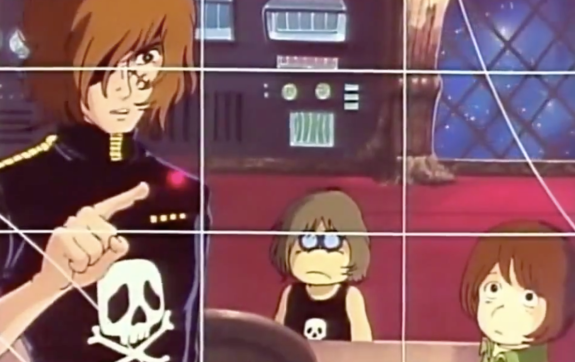
Despite Harlock being a fantastic and iconic character, he, most of the time, isn’t exactly the main character per se. In the original manga, the 1978 TV anime, and a few other adaptations, this position is handed to Tadashi Daiba, a young man who witnessed his father, the famous scientist Dr. Daiba, being killed by the Illumidas. Now filled with a need for fight for freedom more than ever, Tadashi joins forces with Harlock, who greatly admired Dr. Daiba for standing up to the corrupt Earth government. Although starting out as an audience surrogate, Tadashi eventually experiences conflict and grows because of it; by the end becoming somebody that he knows he, his father, and Harlock can be proud of.
Yama (or Logan in the dub), who’s essentially this film’s Tadashi (some fans even call him “CG Tadashi”), goes through a similar process: he starts out as a Gaia spy sent to infiltrate the Arcadia, and for a period of time, acts as an audience surrogate, asking plenty of questions about the Arcadia and the like. When it is revealed that Harlock knew from the get-go that he was a spy, Yama has to deal with the conflict of whether or not to join Harlock (thus betraying the Gaia) or returning to the Gaia and continuing to work for his brother Isora (or Ezra in the dub), thus betraying Harlock in the process. While this is an interesting and unique concept in theory, the way it’s executed completely undermines the whole thing.
Yama betrays both sides of the conflict so often in a 2-hour movie that his character arc ends up looking like sine waves, and neither side is fleshed out enough to make you want to root for Yama joining either of them. Harlock’s scenes with Yama are so few and far between that, when Yama betrays the Gaia for him, you don’t really understand it because Yama barely knows Harlock at this point, though by the end of the film Yama apparently understands Harlock enough to side with him permanently, and even agrees to take up his identity. Likewise, the conflict between Yama and his older brother Isora is only shown in brief character interactions and flashbacks, so when the big reveal comes that the brothers’ childhood friend is only a hologram and has been dead for years, and when Isora destroys her life support system out of anger that she loves Yama more than she loves him, it’s hard to emphasize with Isora since his character doesn’t have much of a presence. This revelation, like Harlock’s, also comes up at a strange point in the movie, making it a lot more of a let down, though I doubt any amount of good pacing could help salvage such an absurd love triangle. I’d say that the closest real bonding moment the two brothers have is when Isora dies, and he, in his dying moments, encourages Yama to join Harlock, which is… very weird. So, while I would’ve loved to see this conflict get more in-depth, the film’s pacing issues and lack of characterization make the whole contention very underwhelming and disappointing.
PART 5: TO CONCLUDE

In conclusion, I’m not against the idea of changing up long-running pieces of fiction. After all, Captain Harlock has existed for a long time, so I can emphasize with the film executives wanting to take the series in a new direction and shed some new creative light onto it. However, when you sacrifice what made the original property so amazing and beloved in the first place in favor of change, the end result is not going to turn out right. And that’s exactly what happened with Captain Harlock 2013.
Sadly, this film is turning out to be one of the most accessible parts of the whole franchise, even landing a spot on one of the most popular streaming services: Netflix. Because of this, I fear that this film is going to be the first Harlock media that new viewers will be exposed to, and I personally do not want this to happen. Space Pirate Captain Harlock as a franchise truly is something special – it’s hopeful, heartwarming, heartbreaking, awe-inspiring, and much, much more. Of course I want more and more people to know about it, I just don’t want it to start with this film. Six months ago, I truly believed that this was one of the best the franchise had to offer, and I’ll tell you this: if I hadn’t reached out and watched more Harlock media, if my experience ended with this film alone, I never would’ve become a fan in the first place. But I’m glad I did. I’ll hereby end this re-examination with this: if you want to get into Harlock, just keep on searching and never lose hope. You’ll find the perfect adaptation that suits you one day. For now, just continue searching in the Sea of Stars. Until next time.
 The Art Archive
One thought on “Analysis: Captain Harlock 2013 – A Re-Examination”