

Welcome back! It’s been a while since the last Retro Retrospective, hasn’t it? Well, it’s time to get back on track and continue with the history of Lupin III! Last time, I mentioned an important staple in the franchise – the TV specials. Remember that! Now, the show must go on.
But first we must backtrack a bit, and shed some light onto a part of the Lupin franchise I forgot to talk about: video games. As far as video games go, I haven’t heard much about them and I have nothing to say about any of them, so you’re free to take a look at them if you wish. The first Lupin video game was released by Taito as a stealth arcade game in 1980. A laserdisc video game titled Cliff Hanger was released to arcades in the US. While it used footage from Cagliostro and and Mamo as cutscenes, it changed the character’s names and has a completely original plot. Since then, several other Lupin video games have been created for many different gaming platforms, such as the Nintendo DS and the Sony Playstation. Now that that’s out of the way, let’s get into it.
The next year, another TV special was shown. Mystery of the Hemingway Papers, released on 20 July 1990, was directed by Osamu Dezaki (remember him?), features Lupin and the gang in the Mediterranean island of Colcaca in pursuit of a box said to hold the draft of Ernest Hemingway’s (yes, I know) final novel, which supposedly describes the locations of great riches. This special is interesting in that it’s the first to have a dangerous conflict between members of Lupin’s gang: not only is Colcaca divided into two factions at war for the Hemingway papers, but Jigen and Goemon have, for their own reasons, teamed up with each of the two factions. So, not only is Lupin trying to uncover the treasure while stopping the war from getting out of hand, he also has to stop two of his friends from possibly having to kill each other, a storyline that has since been repeated several times in the franchise.
In the next two years, two more television specials (both directed by Dezaki) would be released (Steal Napoleon’s Dictionary and From Russia With Love), neither of which were especially notable, but in 1993 Voyage to Danger (or Orders to Assassinate Lupin) was released, this time directed by Masaaki Osumi, director of classic anime TV shows such as Attack No.1 and his adaptation of Moomin, as well as being the director of the Lupin pilot film. This TV special is notable for having a focus on Zenigata, showcasing his respect for Lupin and even helping the gang out of sticky situations.
Unfortunately, while recording lines for Voyage to Danger, Lupin’s voice actor Yasuo Yamada fell suddenly ill, and by the end of the recording process he had to record while in a chair. Nevertheless, Dragon of Doom (or Burn, Zantetsuken!) was released the following year, being the first (and only) special taking place in Hong Kong, but thankfully not the last Lupin media to be centered around (mostly) Goemon.
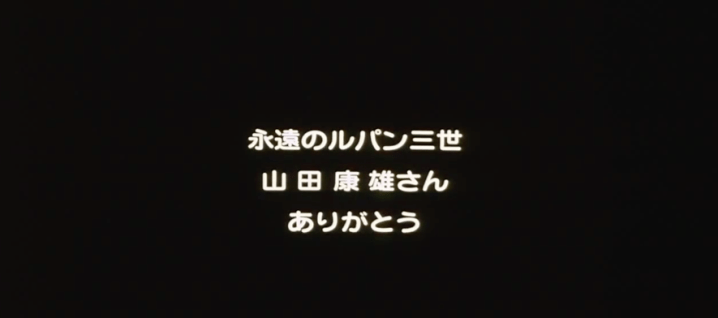
In 1995, there was much excitement surrounding Lupin III, as there was a new theatrical film announced, 10 years after Legend of Gold of Babylon was shown in theaters. The fourth theatrical film in the Lupin franchise, Farewell to Nostradamus (sometimes weirdly referred to as To Hell With Nostradamus!) entered Japanese theaters on April 22, 1995, and is probably the Lupin film with the most epic proportions: a nearly 2 hour long runtime, several different locations for the gang to travel to, high-speed action scenes, and a plot of grand scale involving a doomsday cult. Unsurprisingly, the film was a huge success in Japan. However, the film’s production was faced with tragedy: A few months before release, Yasuo Yamada, who’s health had been on the decline, died of a brain hemorrhage at the age of 62. Kanichi Kurita, a comedian and Yamada’s apprentice, took up the role, and the film was able to be completed on time. Nonetheless, Yamada’s death caused great sadness amongst not only his fellow voice actors, but the fans as well, who all knew him as the voice of their beloved gentleman thief. The film itself is tinged with mournfulness and a sense of loss, as it ends on a rather subdued note, with Iori Sakagami’s somber and wistful “Ai no Suzuki” as the ending song. And last, but not least: after the ending credits are done rolling, a farewell message shows up on screen: “To the eternal Lupin III, Yasuo Yamada: Thank You”.
 The Art Archive