
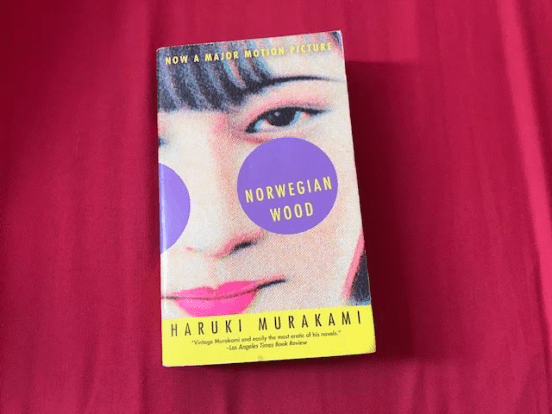
Norwegian Wood (Noruwei no Mori) is a coming-of-age novel by acclaimed Japanese author Haruki Murakami, which was first published in 1987 and was his fifth consecutive novel at the time, written after the release of Hard-Boiled Wonderland and The End of the World in 1985. Despite having released four well-received novels before this, Norwegian Wood is the book that catapulted Murakami to stardom, not only in Japan but abroad, and it’s easy to tell – compared to Hard-Boiled Wonderland, which was published in 1985 but wasn’t translated in English until 1991, Norwegian Wood received its translation only 2 years later in 1989, and since then almost every Murakami book has gotten translated in the span of less than 2 years or so.
Another thing of note is that this book has two translations: the original 1989 translation by Alfred Birnbaum and the updated translation by Jay Rubin in 2000. Although I do not have the 1989 translation, Wikipedia states that it was mainly used by Japanese students learning English and even included an appendix of sorts for several English words and phrases used in the novel. If you are not a Japanese student or if you are comfortable with your English language abilities, I’d recommend the more common Jay Rubin translation.
Despite Murakami’s proficiency and his prolific writing, Norwegian Wood stands out amongst his other novels for several reasons. Unlike most of his other works which often deal with surrealism and fall into the category of “speculative fiction”, Norwegian Wood is a story taking place in average 1960s Tokyo and nothing surreal interferes with the world or its characters. The basic story follows college student Toru as he develops relationships with two different women – the kind but emotionally/mentally unstable Naoko and the outgoing but bossy Midori. Unlike most stories dealing with love triangles, both women are written well, especially in the case of Naoko; despite dealing with an unnamed mental illness, she’s well-rounded and empathetic, which is uncommon when compared to most portrayals of mentally ill people in media.
Overall, even though this is one of his earlier works, it’s one of his best and in general it is wonderfully written. I’d highly recommend this book to new readers of Murakami, so long as you can deal with the 386 page length and the fact that not all of his novels will be as normal and quaint as this one.
 The Art Archive