

Macross. It doesn’t require an introduction. From the airing of its first series in 1982, the Macross franchise has seen very few roadblocks – if the countless sequels, prequels, and spin-offs haven’t already made that obvious. Despite the near infinite franchises in the world of anime that have seen their popularity crash and burn, Macross is one of the few that has managed to stay relevant in the current animanga landscape, and every new entry to the franchise only seems to garner more new fans than the last. But why though?
To explain this, I feel it is first worth explaining what exactly the series is all about anyway. That photo above isn’t exactly indicative of anything, except that it has plenty of cute girls (and guys!) to like. In short: Macross is a multimedia (though the majority of it is, as I said, anime) franchise that combines science-fiction, giant machines, and… idols? Yep. Though every entry in the franchise has a different time, place, and characters, the overall plot has mostly remained the same: In an alternative history of Earth, the galaxy is under attack by a race of aliens known as the Zentradi, whose skills and prowess are far beyond human capability in almost every way… except for the fact that these sad aliens have no culture outside of war. Thankfully, the people back on Earth have decided to use this to their advantage – by employing singers, musicians, or idol groups (depending on the entry) alongside high-tech weapons and machinery to defeat the alien race once and for all.
If you couldn’t already tell, music plays a very important role in Macross, even outside the realms of 2D animation. When one thinks of Macross, it is unlikely that they’ll remember the space battles first: No, they’ll likely remember the songs and the characters that sung them. Which anime-watcher hasn’t at least heard of Lynn Minmay or listened to a Walküre song? It’s safe to say that Macross is intrinsically tied to Japan’s idol culture, and the way that the franchise has adapted to the constant changes in the country’s music scene is what has kept it alive for so long. Space battles may not change, but music certainly does.
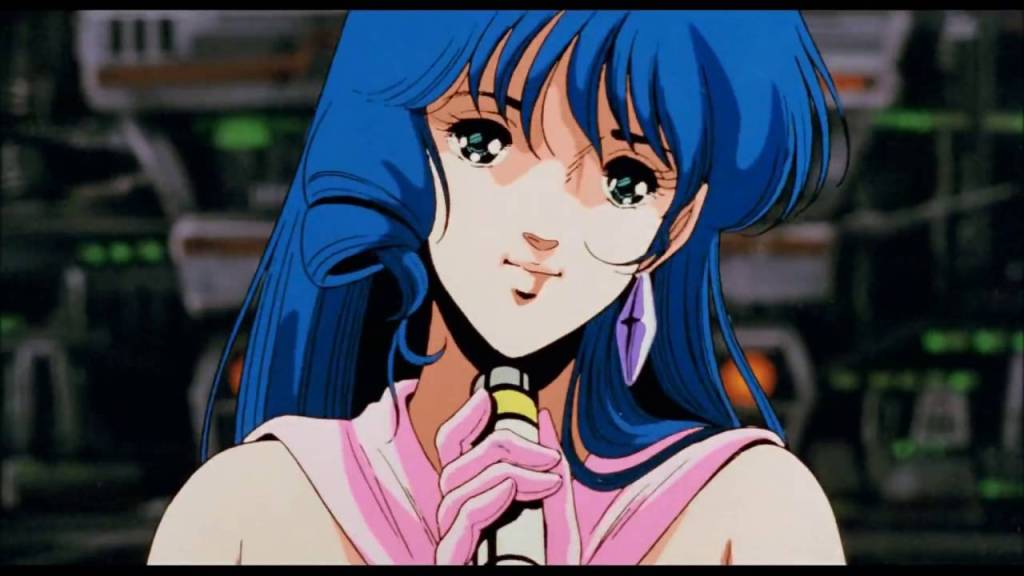
Let’s begin where it all began, with the first Miss Macross: Lynn Minmay. Introduced as a charming, if not somewhat naïve and unreliable young woman, Minmay practically embodied every idol underdog story of the early 80s: Initially working an undesirable part-time job (as a waitress at her uncle’s restaurant), she was nonetheless dead-set on achieving her dream of going pro, and after winning the show’s Miss Macross contest, she was thrust into a world that threatened to tear her down – bloated egos and love triangles included.
If Minmay’s story seems familiar, that’s because it is. Aside from being a typical story in idol-themed films, Minmay’s character and stage personality were very indicative of popular female Japanese solo singers at the time: Young women who excuded the fresh, innocent, glamorous girl-next-door look were all the rage, with idols such as Akina Nakamori and Yukiko Okada dominating the scene. Pop ballads with the themes of love and romance also saw an increase in popularity, creating the blueprint for perhaps the most famous song in all of Macross – the climactic ‘Do you remember love?’ sung by Minmay, used in the movie of the same name. The film and its titular song ranked second and first respectively in the 1984 Anime Grand Prix, a testament to its popularity and impact. Even today, Minmay’s voice actress Mari Ijima continues to sing this song at every convention she attends.

After an OVA and another sequel, the year was 1994, and it was time for a change. Macross Plus, yet another OVA, is released, a side-story and a sequel in the same universe as the 1982 series. Macross Plus is unique in that the idol this time around isn’t even a human being – Sharon Apple, the hottest entertainer in the galaxy, is an AI hologram. In many ways, Sharon was emblematic of both the themes and ideas of early 1990s Japan – a successful economy at its peak, fueled by the ever-present and increasingly normalized rise of technology. Sharon represented a concept that would later become the norm, that being the phenomenon of AI/visual entertainers – these days, you can even find fandoms for visual Youtubers, of all things.
Sharon also represented a growing trend in Japanese music: Techno. Her song Information High features many trademarks of the dance & techno craze that dominated Japan between 1994 and 1997, such as electronic beats, catchy rhythms, and lyrics sung in English. Sharon’s fashion sense is similar in style to her music, being colourful, flashy, and a little otherworldly. However, Macross Plus also used this AI singer as part of a larger message: In a world with rapidly advancing man-machine interface, it is important that there be a least some humanity behind it all.

Meanwhile, the exact same year as the release of the Macross Plus OVA, a very different story was happening in the other Macross release: Macross 7, what I consider to be the ‘black sheep’ of the franchise, if you will. Macross 7 was a massive departure from previous tropes familiar to fans of the series: Instead of having the main duo be a mecha pilot and an idol, the mecha pilot is also an idol – a loud, pacifist-aligned electric guitar player to be exact. In this story, main character Basara Nekki and his female co-protagonist Mylene Jenius are members of a rock & roll band called Fire Bomber, who emphasize pacifism above all and, preferring not to fight the aliens head-on, opt to tame them by blasting soulful rock music from the cockpits of their mechas.
The parallels to real-world music is immediately apparent. The late 90s saw the sudden surge in the popularity of rock bands in Japan, with names such as Glay and L’Arc En Ciel becoming the hot topics of the day. However, rather than reusing the punk & rebel-like themes commonly associated with rock, Fire Bomber’s discography mainly consists of energetic, passionate songs recounting the message of peace & love – somewhat corny, but very much beloved. To this day, Macross 7‘s fictional rock & roll band has released over a dozen albums and several hit singles, with ‘TRY AGAIN’ and ‘DYNAMITE EXPLOSION’ being among the most popular.
After the release follow-ups to Macross 7, as well as a movie version of Macross Plus, there would be no announcement of a new entry to the series until 2002, the 20th anniversary of the franchise: Macross Zero, a prequel to the original 1982 show. It was not only a new decade, but a new millenium. What could be expected next?
Tune in next time…
 The Art Archive