
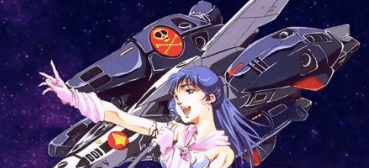
Thanks for tuning in again! Previously, we discussed the influences and impacts of Macross and the Japanese music scene in the good ol’ 80s and 90s. Finishing off with Macross 7 in 1994, we entered the new millenium with the announcement of a new entry to franchise: Macross Zero, the ultimate prequel to the entire series. How would Zero distinguish itself, music-wise?

Here’s the thing about Macross Zero: It takes itself pretty seriously. Set before any of the events of the other Macross entries take place, this 5-episode OVA follows pilot Shin Kudo during the final days of the U.N Wars, whose plane unexpectedly crashes on a seemingly peaceful island. The main heroine, a young native priestess called Sara Nome, is highly skeptical of outsiders and initially does not engage with Shin, but this all changes when a secret connecting the island’s inhabitants with a mysterious alien spaceship that crashed there nine years earlier is found, and both sides of the war desperately scramble to make the island their battleground. As the events spiral out of control, Shin, Sara, and her younger sister Mao, are forced to defend their homeland – even if it means death.
You may have noticed that I haven’t mentioned any music or songs, and that’s because Zero doesn’t really have any, but what songs it does have very much do make it unique enough to stand on its own. The soundtrack takes obvious inspiration from tribal songs and religious motifs, with songs such as ‘Arkan‘ and ‘Forest Song‘ being the most obvious. Indeed, Zero’s definition of an ‘idol’ is a lot more literal.

As Macross Zero ended in 2004 and the 2000s continued, the next Macross series wouldn’t have to hide for very long. Macross Frontier, released in 2007, is one of the most popular in the franchise, and for good reason: Now we have two idols! Frontier saw the franchise return to its ‘love triangle’ plotline formula, now with our protagonist Alto left with two girls to choose from – the beautiful, self-assured Sheryl Nome (reminiscent in both physical appearance and personality to mid-2000s pop stars) and the lively, cheerful Ranka Lee, who aspires to be a singer, just like her inspiration, Sheryl.
Now with two fictional idols at the frontline, the addition of composer Yoko Kanno (of Cowboy Bebop fame) to the crew, and the voices of Japanese pop singers May’n and Megumi Nakajima as Sheryl and Ranka respectively, it is no wonder that the music of Macross Frontier is some of the series’ most diverse and well-known. Both singers have quite the range – Sheryl (May’n) has songs that exude powerful vocals such as ‘Northern Cross‘, more Britney Spears-esque pop like ‘Pink Monsoon‘, and even sad ballads (‘Diamond Crevasse‘). Ranka (Nakajima) is no slacker, either. Ranka is the embodiment of cute and upbeat, with songs such as ‘Seikan Hikou‘ and ‘Koi wa Dogfight‘ being prime examples. She’s no stranger to powerful ballads either, as ‘Aimo‘ would have you know. The musical prowess of both ladies would be impossible to capture in a single article – the hour-long compilations of Frontier songs on YouTube are a testament to that.

With all of the well-earned success of Frontier, it was inevitable that this particular series had a gorilla-tight grip on the entire franchise for many years following its release. After many movies, spin-offs, and even a crossover with Macross 7, something new leapt onto the scene – Macross Delta, the latest installment of the franchise, released in 2016. At this point, idol groups were (and still are) all the rage in Japan, with the number of idol groups skyrocketing in the 2010s onwards. Their influence was not just limited to the physical realm, as anime featuring female-exclusive idol groups also became massively popular, such as Love Live! and The Idolm@ster. Given this obvious trend, it wasn’t surprising that the Macross franchise would also follow suit and introduce Walküre, a five-person strong girl group set on saving the galaxy with technicolour hair and rhythms.
Of course, each of Walküre’s members have their own solo songs, but, like all idol groups, their real strength comes from performing together. The girls’ ‘brand’ is generally composed of catchy, encouraging pop songs like ‘Change!!!‘ and ‘Walküre ga Tomaranai‘, but they will occasionally veer into trying something a little different, like the dramatic ‘Hametsu no Junjou‘ or the surprisingly emotional ‘Giraffe Blues‘. Some of the solo songs are also standouts, especially ‘Ikenai Borderline‘. A strange and somewhat hilarious case can be made for the song ‘Rune ga Pikatto Hikarittara’, which had a chorus that sounded a little too similar to that of ‘September’ by Earth Wind & Fire, leading to this song mashup. Unexpected, but I like it.
That, ladies and gentlemen, concludes our exploration of Macross and how idol culture has affected the franchise. Whether you’re more of a Fire Bomber or Walküre fan, it’s obvious that this series has always kept a close eye on the music industry and all its latest trends, and its a big reason why the franchise still holds up today – every installment is a time capsule to a particular period of time in not only anime culture, but music culture as well.
 The Art Archive