
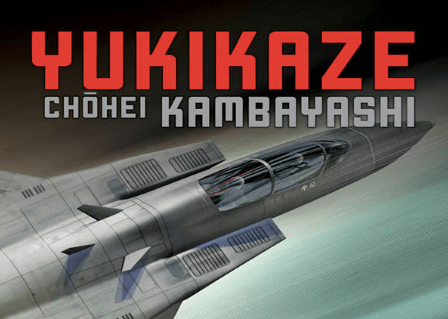
A franchise is a fickle thing. Not every piece of standalone media can become a franchise, and not every franchise can become successful – depending on what your measure of success is, of course – and when it comes to Japanese-produced media, this measure of success is no more apparent when comparing how well it is received in its home country and in overseas territories. To me, no other franchise encapsulates this sort of dichotomy better than Yukikaze, a multi-media series that started out as monthly chapters published in a science-fiction magazine and has since branched out into several different adaptations – none of which have really been that well-received outside of Japan and all of which have problems that hinder whatever possible success they might’ve had. But let’s put in a pin in that for a minute, since you’re probably scratching your head and wondering what the hell a “Yukikaze” is. Let’s get into that.
To briefly summarize: Sentou Yousei Yukikaze (tl. Battle Fairy Yukikaze or simply Yukikaze) is a series of novels written by the incredibly prolific and well-respected author Chohei Kambayashi. As stated previously, it originally began life as a series of short chapters published in S-F Magazine from 1979 to 1983, and these chapters were eventually compiled into the first novel in 1984. After the release of the first novel, sequel chapters started publishing in the magazine again in 1992 and were also compiled into the sequel, Good Luck Yukikaze, in 1999. After a seven-year break, the now-trilogy continued in 2006 and in 2009 was published in book format as Unbroken Arrow. Believe it or not, it doesn’t end there. After a (no less than) 10-year break, the story is still ongoing as of December 2019, and will likely also release in book format when it ends as well. The fact that this story has been able to continue and stay in the public consciousness for so long really cements its place as one of the most groundbreaking pieces of sci-fi fiction in Japan, akin to what Starship Troopers did for sci-fi fiction in the US.
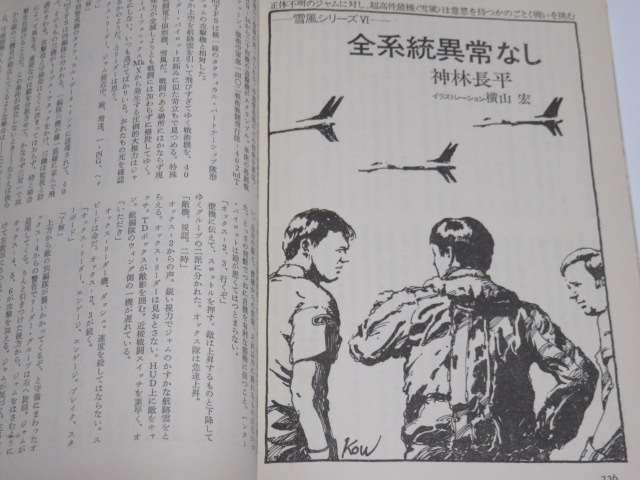
Unlike the update schedule of its creator, the actual plot of these novels is a little easier to describe. In short, the story centers around ace pilot Rei Fukai and his plane, nicknamed ‘Yukikaze’, a state-of-the-art tactical reconnaissance aircraft equipped with a near sentient AI system. The main story follows Rei as both he and his plane observe the actions of the mysterious and unpredictable alien beings known as the JAM, who have been ‘at war’ with mankind for 33 years and counting. Given how long these novels have been going for, the story has focused on several different themes, mainly concerning the use of technology, the effects of war on soldiers, and how the relationship between humans and AI can be equally as beneficial as it is damaging. I wouldn’t want to spoil too much, but if you ever get the chance, I highly recommend it. Though its themes and in-world tech may be considered outdated by today’s standards, it is a nonetheless fascinating insight into how our use of artificial systems can have both individual and far-reaching consequences, as Rei’s relationship with Yukikaze (more specifically, Yukikaze’s AI) is the series’ most engaging focal point.
So, if it’s so great, what’s the issue?
To understand this, I feel that it’s important to preface with a little insight into the animanga community’s relationship with source materials. Before going any further, know this: In general, they do not like to read. Period, full stop, end of sentence. It’s why you see so much infighting between fans of an anime and fans of the original source material, be it a manga, novel, or anything else. It’s why the phrase “READ THE ___” has become so widely known within the community. I can’t really fault these “anime-only” fans: Depending on what the source material is, reading it all can be incredibly time-consuming to say the least, especially if you don’t consider yourself a fast reader. This doesn’t even only apply to print material, just ask any Fate/Stay Night fan who has the read the original visual novel to weigh in, with the first and easiest (I repeat, first and easiest) route taking up to 50 hours for the average person to complete. You can see why so many people would rather just stick to an adaptation.
However, this isn’t really what I consider the reason as to why the books aren’t well-known. Actually, the main reason as to why these novels never really took off has little to nothing to do with an unwillingness to read. Rather than this being a case of fans not wanting to read them, it’s a case of fans not being able to even access them. So… yeah, let’s talk how these novels were distributed, or rather, how they weren’t. Trust me, it all adds up eventually.
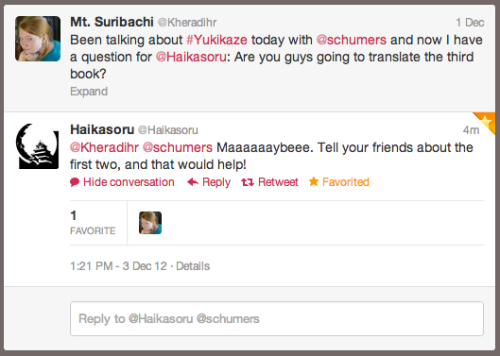
For a very long time, the novels were practically inaccessible outside of Japan, translated or not. The first novel was not released in English until 2010, and the sequel followed suit in 2011. That’s right, it took almost 30 years for the first book to ever be seen abroad. Now, I’m not trying to bash the company or those who worked on translating the two novels. Credit where credit is due, both have surprisingly accurate and serviceable translations, and it’s clear to me that a lot of time and effort was spent making it as polished as it could be. Translating a novel that requires an entire fact sheet and a section for all the military jargon used is certainly no easy feat. However, you may have noticed that I’ve said “the two novels”, even though there are three that are out right now, and that’s because the third novel has still not been translated and there is a slim chance that it ever will be. This is because HaikaSoru, the publishing house that released the first two overseas, ceased activities after completing their releases of all 10 Legend of the Galactic Hero novels. Moreover, they had previously hinted that they might commission a translation should sales of the first two books pick up, but sadly that appears to have fallen through. All in all, a rather unfortunate state of things.
As a final note to top off this first part, I want to once again state how this lateness in bringing over any original source material hurts the potential reputation of any series or franchise. When a source material like this takes this long to be seen outside of its home country, the only choice both fans and newcomers have is adaptations, which, more often than not, do not offer a fully-realised and complete portrayal of said source material. Sure, an adaptation might get more fans interested in seeing its origin point (as you’ve probably seen with talking points like “the book was better”), but in cases like these, the lack of easy accessibility from the get-go does not bode well for a franchise in the long-term.
In the time that it took for the first Yukikaze novel to be published overseas, a 5-episode OVA, a spin-off OAV, a 6-chapter manga, and a video game were released, all with varying levels of quality. We’ll discuss these adaptations in part 2, and hopefully it’ll be a lot more fun. Until then…
 The Art Archive
One thought on “Yukikaze: A Troubled Masterpiece (Part 1)”