
In recent years, there have been no type of anime fans quite as envied as the figure collectors. It’s a unique phenomenon that really only caters to fans of Japanese-made media – after all, in the West, what comes to mind when figures are mentioned can be boiled down to only two categories: Either those hyper-realistic figures that you find at your local comic book shop, or… Funko Pops. In Japan, however, your options are nearly endless: classic full-body figurines, actual dolls, nendoroids (smaller ‘chibi’ figures), figmas (pose-able figures), plastic models, garage kits, and more. So big is the market for these figures in Japan (and other countries in Asia), that you can even try your luck at winning figures for just a few tokens at a claw machine game – and thanks to English-language sites like AmiAmi, Tokyo Otaku Mode, and HobbyLink Japan just to name a few, purchasing these straight from the source has become even easier for Western fans. Needless to say, it’s become an endearing hobby for many across the globe, with some collectors even buying tall glass cases to display their items, as your grandma might do with her ceramic statues. And you may scoff, but they have good reason to do this.

Take a look at the figure above, of two characters from the anime No Game No Life, currently up for pre-order on AmiAmi. You can see the amount of detail and work that goes into producing figures, from clothing wrinkles to skin-tone shading to even strands of hair. Pretty impressive! However, to own such a piece of art comes with a price… literally. This figure is currently selling for 37,800 JPY, or approximately 342 USD. Even a less dramatic figure of just one character and without as many details, such as this one, is going for 181 USD. Even nendoroids, essentially smaller ‘chibi’ figures, can sell for up to 60 USD on occasion. Simply put, figures are definitely not cheap, and a lot of Western otaku have to resort to drastic purchasing measures – often buying from non-reputable sites like AliExpress, Ebay, or Mercari. Sadly, what they receive is, most of the time, a bootleg of varying quality. This is where the Instagram account uglybootlegfigures comes into play, where users can submit their often hilariously bad pictures and stories of bootleg figures. For me , scrolling through the account was a great pick-me-up… but then I began to notice something. Sure, there’s all sorts of bootlegs to feast your eyes on from all sorts of franchises, but there were two figures in particular that were repeated near constantly: Sakura Miku and “Show Miku 2016”. With that, I began a mission to uncover their “true forms” and theorise as to why these in particular are everywhere.

But, first and foremost: Who is Hatsune Miku? In short, Miku is a Vocaloid, a vocal synthesizer created by the company Crypton Future Media, to be used by musicians who could use her voice in their songs free-range. Since her release in 2007, Miku’s accessibility and her iconic character design has made her one of the most recognisable virtual idols in the world, despite the fact that she is, at base value, an anthropomorphic voicebank. Her success has led to several themed different designs – one being Sakura Miku, a pastel pink Miku based on the classic cherry blossom trees, and the other referred to as “Snow Miku”, a winter-themed Miku whose outfit changes every year based on fan submissions and a voting process. Now that you know the background of Miku and what these two bootlegs are based on, let’s investigate their prevalence, and where they even originated from.
The appeal and prevalence of that one Sakura Miku figure are obvious. Her pink design is adorable, and I imagine that for many fans it is more appealing to the eye than Miku’s original silver/black/turquoise look. Furthermore, for those whose figures revolve around the cuteness factor or for those who stick to a pink theme, it’s a great chance for them to showcase a figure of an iconic staple of Japanese media without sacrificing their personal aesthetic. As for the original figure, this required a bit of searching. Though I did check on the three English-language sites mentioned previously, this particular figure was nowhere to be found, which led me to consult good ol’ Google, and lo and behold… the original figure was there in plain sight.
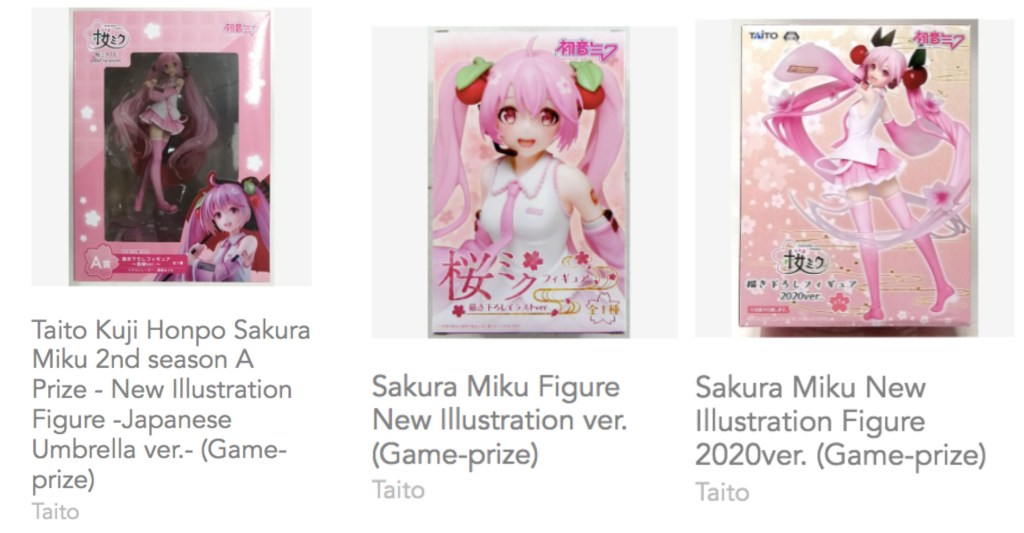
However, if I were to get to the bottom of this, I would have to check a reliable seller. Thankfully, another site that ships figures from Japan is Ninoma, which had more information on this particular figure – it was produced by the company Taito and was released in the Spring of 2019. Still, I needed more information, so I searched for that company on AmiAmi, and would you know it, they’ve actually produced several Sakura Miku figures before, some of which you can see below. Does one look familiar? Interestingly enough, these three figures all have one commonality: They’re all the sorts of figures you could win from a game (like the claw machines I mentioned), hence why it says “Game-prize” on all their titles. This to me provided a possible answer as to why that one is so heavily bootlegged. For instance, compared to the other two, 2019 Miku is simply standing and smiling, not doing a complicated and flowy pose like 2020 Miku or holding an accessory like Umbrella Miku, making her the easiest to replicate. Moreover, she’s a game figure – while perfectly serviceable for what they are, game figures aren’t the most detailed or of the highest quality, another factor that makes her an easy target for bootleggers. Now that that mystery is solved, let’s move on to “Show Miku 2016”.
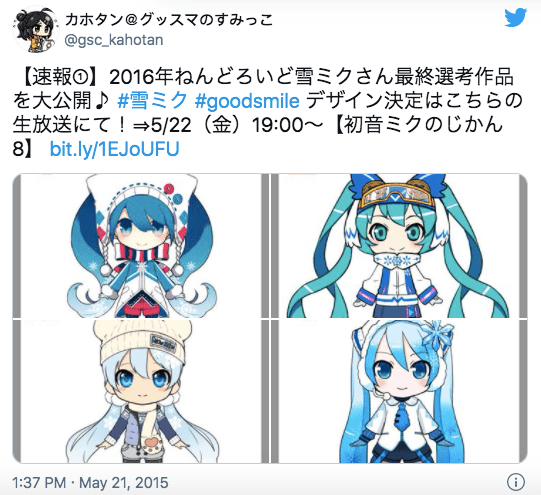
Show Miku (as I’ll call her from now on) has an interesting story. I first thought that, since her bootleg boxes all have a snowflake design on them, that “Show” was simply a misspelling of “Snow” and that this figure was in some way related to the Snow Miku 2016 figures. Unfortunately this was not the case – looking up Snow Miku 2016 yields plenty of figures for that years actual winning design, Miku dressed as a snowboarder. Thinking that that bootleg was based of any other competing designs also did not help, as none of the others are even remotely polar-bear themed at all (see the image). Moreover, given how ridiculously detailed and creative most Snow Miku designs can get, there’s a very little chance that a concept that simple would ever win or be made into a figure.
Nevertheless, something that caught my attention in the comment section on most of the posts with Show Miku bootlegs was that a few people implied that this wasn’t even a bootleg of an official figure – rather, the original was a fanmade figure based off of a piece of fanart, and that somehow it had become easy pickings for bootleg companies. Now, if this were true it would be outrageous, so I searched to see if this figure was sold on any sites that directly imported from Japan. It was frustrating at first, having to comb through tons of bootlegs sold on Amazon and such sites, but I finally found one that offered more clues. This figure was, at one point, sold on the site Le Monde de Romy, a small French site that mainly sold Disney items with a few Japanese ones as well. On the site, I took a closer look at the box it came in, and noticed a few strange details. Despite the fact that the box stated “Snow Miku 2016” (spelled correctly this time), the product information box stated that it was made in 2012 and that it was ‘rare’. Moreover, the box had a “Made in China” label and featured the logo of Xinhao, a Chinese manufacturing company.
More clues on the back of the box were even more confusing. The only clue in English (aside from the Snow Miku 2016) was “Snowy Owl Ver.” – which, when looked up, is the actual nendoroid for the winning Snow Miku 2016 design – once again, leaving me at a dead end. But, back to the original theory: Was the figure based on fanart? A PNG of the original art it was supposedly based on was posted by a DeviantArt user in 2013 (matching up with the supposed release date), and since I saw it quite a few times while researching, I decided that this must be the original art. However, reverse searching the art itself on Google (even searching by time) leads to no results as to who actually drew it. Suddenly remembering the website SauceNao, another reverse image search site, I hoped that this last resort could finally lead me to the source. The only links SauceNao gave me were reposts of the art on DeviantArt, but I took the chance anyway. By pure luck, a fellow user named xSweetSlayerx had commented one of these reposts in 2019, providing the honest-to-God source: It was by the user FireGodLeo on Pixiv (the Japanese equivalent of DeviantArt), and was posted in October 2011. Furthermore, this fanart is based on an actual piece of merchandise: a rare Snow Miku February 2011 plush toy where her alternate costume is that of a polar bear. Sadly, despite having a figure based off of their art and their art itself being reposted everywhere, I haven’t found any mentions of this user being aware of either of these things at all. Though I obviously don’t know the full story of this insane rabbit hole, and since this goes back to a decade ago, what I can say is this: At some point, someone might have made a fanmade figure of FireGodLeo’s piece and sold it online. Somehow, bootleggers got a hold of it, and given its small size and lack of details, have easily replicated it. Since it was probably sold without an official box, that is why it is typically sold in the box meant for the actual 2016 Snow Miku nendoroid.
Well, that was certainly a wild ride! It was a lot of fun learning about these bizarre yet charming (in their own way) bootlegs, and hopefully you’ve learned to always buy your merch from a reliable source from now on. Though I must say, as an artist myself, it was very disheartening to learn about the real truth behind the Show Miku bootleg, and how the artist has likely never seen a single cent from that one piece of fanart. To close off, I’ll leave FireGodLeo’s actual Pixiv Booth here – it’s an official service for Pixiv artist to sell their own goods (that ships worldwide!) and you can buy yourself some adorable Miku acrylic key-holders or stands for the price of only 6 dollars, instead of wasting hard-earned money on an unofficial bootleg.
Thanks for reading!
 The Art Archive