
Let’s say, hypothetically, someone put a gun to your head and asked you to name one long-running science fiction film franchise. You’d probably answer with Star Wars (as would the majority of people), some small minority would say the Star Trek films., and… that’s kind of it. Despite how endearingly popular the sci-fi genre is in every type of media, there haven’t really been many long-lasting sci-fi film series at all – and since the Star Wars sequel trilogy wrapped up in 2019, there’s been nothing new to be interested in. But, a new challenger has entered the fray, and that challenger is Denis Villeneuve’s Dune, an adaptation of the 1965 novel of the same name by Frank Herbert. As someone who has read the novel and liked it well enough, I awaited this film with cautious optimism – and finally got to see it.
Assuming you haven’t already read the novel or at least know the basics of the plot, allow me to explain: The story follows Paul Atreides (Timothée Chalamet ), the only son and heir of the noble House Atreides, who has recently been haunted by strange premonitions in his dreams. His father, Duke Leto Atreides (Oscar Isaac ) is assigned by the all-seeing Emperor to replace House Harkonnen as the de-facto rulers of Arrakis, a merciless desert planet whose only inhabitants include deadly giant worms and the native population – skilled and determined fighters known as the Fremen. As it turns out, however, the resistant populace and scary creatures are the least that House Atreides have to worry about – Paul’s dreams have become more ominous, and the stage is set for war.
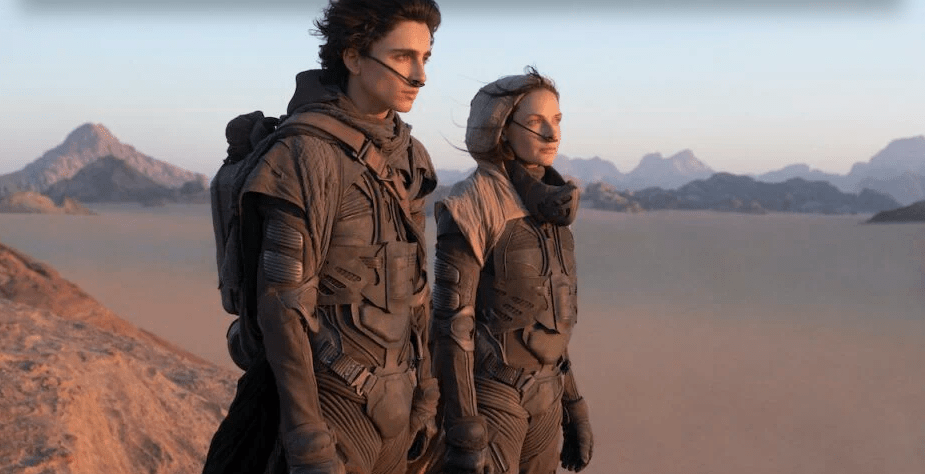
Let’s get the obvious out of the way first: This film is just beautiful to watch and hear, period. Villeneuve has perfected the visuals of this universe with an incredible sense of atmosphere and scale; by the end, I was fully immersed in the world of Arrakis. The cinematography contributes to this beauty, of course – many of the shots in this film are simply jaw-dropping, and even better if you watch in 3D (like I did). The audio is no slouch in this department either, with both an ethereal soundscape and a wonderful score by Hans Zimmer contributing to the immersive experience that is Dune. Something else that caught my attention is the acting. As you may have noticed, a lot of famous actors are in this film, and they do not disappoint. To be honest, I entered the cinema fully expecting to make fun of Timotheé Chalamet by the end of it, but he delivers a very subtle yet powerful performance as Paul. However, the real star of the show is, without a doubt, Rebecca Ferguson as Paul’s mother, Lady Jessica. Her performance is, like Chalamet’s, subtle yet powerful – you feel her struggle between her desire to live up to the legacy of the Bene Gesserit and her love for her son. Both Ferguson and Chalamet provide the strongest emotional core of the film, and it’s all great to watch. I know it’s become a meme to describe things as being ‘epic’, but this is epic.
Now onto the not-so-great things, so first things first: This film is in no way a complete adaptation of the novel. At this point, it’s already public knowledge that Villeneuve is planning to adapt the first novel as a two-part film series – thus, this film and its entire almost 2-and-a-half hour long runtime is basically buildup for what will happen next. Now, I can see why this aspect is one that will likely turn off some audiences, since a lot of it is devoted entirely to worldbuilding and space politics, but here’s the thing: I personally wasn’t that bothered by it. Yes, Dune is long and drags at times (on that note, I take back what I said about No Time To Die being long), and admittedly some of the more boring politics-esque scenes are indeed boring. But here’s the thing: This is Dune we’re talking about, and if you’re even going to attempt to make a proper adaptation, then the worldbuilding and politics have to matter just as much as every other story element. Dune’s unique approach to its world and how it works is one of the things that have made the series so renowned, after all. Something else worth mentioning is that this film is very clearly one that relies on audiences being in a cinema to fully experience its incredible audiovisual effects. Not that you can’t still enjoy the film on your television screen on computer monitor, but I’d be lying if I said that not seeing it on the proper big screen doesn’t take away from the experience somewhat. Unfortunately, thanks to the you-know-what, this is something that most moviegoers will have no control over.
Therefore, on the whole: I really liked it! It’s exciting seeing such an iconic piece of sci-fi literature finally get the film adaptation it deserves (sorry, David Lynch), and, even if you don’t think it’ll be that interesting or cannot access the cinema at the moment, I still encourage you to give it a shot. It’s definitely one you’d regret missing.
Final score: 9/10
 The Art Archive