Anime Review: I Want to Eat Your Pancreas

93b9cf2c33fdc72b89ada0c77a015686.jpg

Before anyone asks: Yes, that’s the actual title of this film. I know. It’s a weird and silly enough title to turn one completely off on watching it. At first, I was only willing to give it a passing a glance and go “Huh, that’s anime for you” and never touch it again. However, having seen one of my acquaintances watch it and highly enjoy it, I decided to save it for a rainy day and hopefully get around it at some point. As you can clearly tell, I did get around to watching it; otherwise you wouldn’t be reading this review. But before we get into it, what’s this even about?

Directed by Shin’ichiro Ushijima and adapted from a former web-novel of the same name by Yoru Sumino, I Want to Eat Your Pancreas (Kimi no Suizō o Tabetai in Japanesefollows the life of a introverted and reclusive high school boy (who makes it a point never to say people’s names out loud or reveal his own) and his accidental meeting with Sakura Yamauchi, a bright and peppy girl in his class (also his disinterested library assistant). This boy-meets-girl story is twisted upside-down when he realizes that Sakura has terminal pancreatic cancer – and he’s the only person outside her immediate family who knows. Not wanting to waste a moment, Sakura immediately invites him to be her “partner” in her bucket list escapades, to which he hesitantly agrees – but will he be able to stay by her side until the end?

I’m personally not the biggest fan of the whole “sickness romance” genre, and the last I remember consuming of it was when I read The Fault in Our Stars all those years ago. However, this film is surprisingly interesting and subversive in that sense. The relationship between our MC and Sakura is slowly but carefully built up, and it never tries to be too dramatic or melancholic. Sakura herself isn’t all moody about her condition either, and her excitement in crossing items of her bucket list is well-matched with the more down-to-earth MC, who always reminds her of the reality but is never overbearing or annoying about it. This ying-yang pair influence each other in various ways throughout the almost two-hour long film, and their influences can be understood. The animation, although not anything overly special or bombastic, remains consistent throughout, and there are a a few scenes that stand out as being especially beautiful.

Despite this praise, there’s more things that may annoy one about this film other than the oddball title. If the almost two-hour runtime doesn’t already make you bored, it should go without saying that the first third or so is quite slow-paced, and it takes a while before the MC is able to break out of his book-covered shell and get the ball rolling. Moreover, there’s a few extended scenes that consist of little more that characters contemplating in either silence or with soft piano music playing in the background (great soundtrack, by the way) that may leave more than a few people spiritless. However, if you’re willing to stick through these minor issues, it’s an ultimately rewarding experience.

In a way, this film is less about coming to terms with dying but more about coming to terms with living and what that all means. Even though you may not understand it or where its all going at first, everything will make sense in the end. And who knows, you may even have a changed perspective on life!

Final score: 8/10
Anime Review: Adieu Galaxy Express 999

Screen Shot 2018-07-03 at 6.23.35 PM.png

Time for a little-known piece of trivia: did you know that the classic 1979 anime film Galaxy Express 999 had a sequel? I didn’t, either. Alas, this seems to be the fate that many sequels share, especially those of classic anime. Seriously, how many people do you think know about the existence Eureka Seven AO or Ghost in the Shell: Innocence? Sadly, many sequels, whether or not they’re done in TV, movie, manga etc. form, are more often than not, forgotten about. However, whether or not they’re actually good, satisfactory, manage to tie up a story or present a newer one (while still keeping similar elements as the previous incarnation) is an entirely different ball game. When I discovered that there was a sequel to GE999, I found almost no reviews online, so I decided to take matters into my own hands and watched the film in its entirety. Thank me later. Maybe this’ll show up on Google one day. Let me know if it does.

But I digress. The plot of Adieu Galaxy Express 999 (also known as Adieu Galaxy Express 999: Final Station Andromeda) goes as follows: Set two years after the events of the first film, our main protagonist, Tetsuro Hoshino, now a bit older, has joined an Earth resistance fighting against the Machine People, led by Queen Promethium, who is still a fearsome entity despite having lost her physical form in the previous film. He has abandoned all hope of ever seeing his beloved Maetel or the Galaxy Express 999 itself ever again.. until he receives an automated message from Maetel, urging him to rejoin her on the 999 for an unknown reason. When he does, she is nowhere to be seen, and the train starts behaving erratically, moving on its own course. Tetsuro, once again, must embark on a journey away from his venerated Earth, to distant planets, all the while dealing with vicious enemies and meeting up with fellow allies, both new and old. And this time, he vows to find Maetel, defeat Queen Promethium, and end this conflict once and for all.

Screen Shot 2018-07-03 at 7.23.03 PM.png

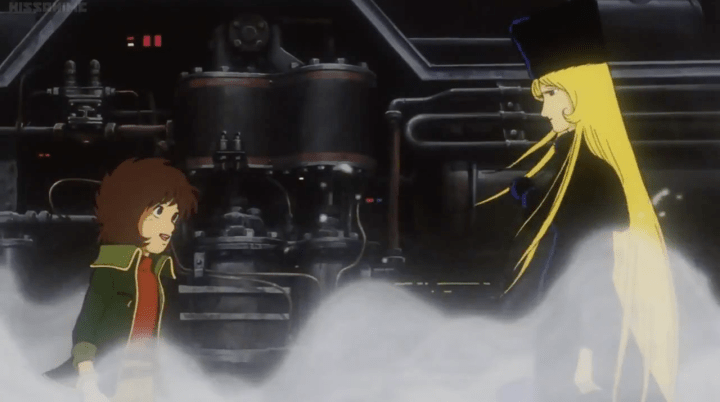
Here’s my main case for this sequel: it’s a great film, but it’s also a terrible film. I’ll explain by listing what I enjoyed about it. First of all, the animation was simply stunning; director Rintaro (who also directed the first GE999 film and the 1978 Captain Harlock TV series) was certainly no slouch in that department. He made full use of his visual creativity and his position as director, making almost every sequence in the movie into an arthouse moment, which I’m sure must’ve blown people away in 1981, considering it still looks good even now. In many ways, the animation is much better than its predecessor, and visually, its much better than the original. That screencap I put up there won’t do it justice. In addition, many of the questions that are posed in the first movie are wrapped up, albeit a bit hastily.

However, this is where my praise must unfortunately stop, because almost everything else in the movie is… not good. You see, although it was marketed as the conclusion to the Galaxy Express series, neither the manga nor the TV adaptation would actually be concluded until a few months later. Not to spoil anything, but after watching it all the way through, the notion that even the film itself tried to make the ending seem like it had all the gravity of being the legit ending of the sci-fi story is very odd, considering it was nothing of the sort for the majority of its 2 hour runtime. This brings me to my next, slightly exaggerated issue: nothing happens. Yes, many of the questions were wrapped up (as mentioned above), but besides that, pretty much nothing of narrative importance occurs. The first film had the narrative of Tetsuro on a quest for vengeance against the Machine People for killing his mom, while at the same time learning about what it means to be human by learning about and growing closer to Maetel, Captain Harlock, Tochiro, and others, the narrative for this one is… the 999 is somehow going off-course and nobody knows where it’s going, and Tetsuro wanting to find Maetel again because, well, she told him to come.

Screen Shot 2018-07-01 at 8.21.17 PM.png

Remember those impressive animation sequences I mentioned earlier? Although they are gorgeous from an art perspective, they are, 90% of the time, placed in a scene where nothing of emotional importance happens. The first movie very much rode off of the emotions of the characters while at the same time having an over-arching narrative, and there, Rintaro’s artfully-crafted sequences worked a lot better, since there was actually something the viewers could experience and relate to happening in the scene, whether it be sadness, happiness, anger, etc. Here, although all of the characters from the previous film were present, nothing is done with them emotionally (or narratively for that matter), therefore all those artsy scenes, which were meant to make the audience feel something, lose all their intended emotional value.

In conclusion, Adieu Galaxy Express 999 is not a film with no redeeming qualities, In fact, I’d personally say it’s a bit hard to dislike it simply because of how wonderful and artistic it looks. But if you’re considering watching this, watch it for the visuals alone, otherwise you’ll be disappointed. You’re probably better off watching the first film instead.

Final score: 5/10


Anime Review: Like the Clouds, Like the Wind

DbgN5mxVQAEFuFa.jpg


Like the Clouds, Like the Wind (known as Kumo no You ni Kaze no You ni or just Kumo Kaze) is an OVA (original video animation) that was based on a book called Inner Palace Harem Story, which won the first Japan Fantasy Novel Award in 1989, which of course led it to receiving an anime adaptation, which was broadcasted on TV on March 21, 1990. In truth, I’ve been meaning to watch it for a while now, but when Discotek Media announced that the OVA would be released on DVD in June, I decided to stop stalling around and get to watching it. So, how was it?

The story of Kumo Kaze revolves around a young girl named Ginga, who lives in the Chinese countryside with her father, sometime in the 1600s, enjoying a menial farmers’ life. When the 17th Sokan Emperor dies and his son prepares to ascend the throne, the winds of revolution and political intrigue start to blow. But even despite the difficulties of his ascension, the new emperor must still find himself an empress. The call goes out across the nation for girls to join the contest, and soon the Forbidden City is filled with young women training and competing for the chance to become empress – and who should be among them but Ginga! Although she only joins at first because she thinks that having 3 meals a day and an education sounds like a good deal, she ends up getting more than she bargained for in the process, and must rise to the challenge along with her fellow candidates, and to the dangers threatening the government she has become a part of.

One of the first aspects of this OVA that I liked was the Studio Ghibli-esque style and animation, provided by character designer Katsuya Kondō, who has served as a character designer and lead animator for several famous Ghibli projects, such as Ponyo and Castle in the Sky. Every character looks different in their own way, and they are usually very animated, with a wide variety of facial expressions suited to their specific moods. In addition, the characters had their own unique quirks and some sense of personality, such as Ginga’s enthusiasm and childness, Kōyō’s calmness and monotone voice, Sesshamin’s aristocracy and elegance, and more. Moreover, for all the simplicity in Katsuya’s designs, it isn’t afraid to delve into more adult themes, such politics, war, and the deaths of loved ones. It was also refreshing to have an anime that was centered in another country, namely, China.

However, this is where my praise for this OVA ends. Although the characters do have their fair share of quirks, they’re all pretty unmemorable, as these character tropes have been plenty of times before. I mean, where haven’t you seen the “plucky and naive girl is thrust into a dangerous situation and benefits from it” trope before? Other than the character designs, all other animation and designs are nothing special, although there are some pretty-looking establishing shots of the Forbidden City that I liked, having lived in Beijing for 2 years. The story is average as well, being your typical run-of-the-mill “underdog rises to greatness” fare, and it doesn’t take that much attention to piece together what’s going to happen next. The action scenes present here aren’t that special, and there aren’t exactly any memorable non-action scenes either, since there is no piece of animation or dialogue that stands out from the rest. Overall, the main problem with this OVA is how forgettable and bland it is.

In conclusion, Kumo Kaze isn’t a bad OVA. But it isn’t one of the greatest either. As far as OVAs go, there are plenty other fish in the sea. It’s a fun watch for the first time, but don’t expect it to be something that you come back to.

Final score: 6/10

Anime Review: Night on the Galactic Railroad

night-on-the-galactic-railroad-dub.png.jpeg


Night on the Galactic Railroad is 1985 animated movie directed by Gisaburo Sugii, with a screenplay by Minoru Betsuyaku and music by Haruomi Hosono. The movie is an adaptation of the classic children’s novel written by Kenji Miyazawa, who was inspired to write it after he went on a railroad trip to Sakhalin, a trip he took to get over the grief he felt after his beloved sister Toshi passed away in 1922. He kept on steadily working on it until his death in 1933. The middle part of the novel was never completed, but it was published as it was nonetheless.


The movie tells the story of a young boy named Giovanni, who’s life has been quite hard. Her father is more often away at sea than not, he must look after his sick mother and work for a living, all while enduring plenty of teasing from his classmates, who all torment him daily except for his childhood friend, Campanella. Giovanni hopes to go to the Festival of the Centaurus with Campanella, but when he is tormented yet again by the boys, he gives up, and climbs the hill overlooking his village to be alone with his sadness. Suddenly, seemingly out of nowhere, a giant steam train appears! The next thing he knows, he’s riding on board alongside none other than… Campanella. It turns out they’re on the Galactic Railroad, and are about to depart on a journey through the vastness of time and space…


The animated adaptation is very unique, to say the least. Firstly, there was the choice of depict most of the cast as cats, probably due to the difficulty of animating humans. However, the fact that they are cats doesn’t make them any less relatable; they’re as human as can be, and the audience can sympathize and relate to them. Second, there’s the very atmospheric and experimental soundtrack done by Haruomi Hosono, which ranges from cheerful to dark to haunting, to accommodate the film’s many tones. Lastly, there’s the slow –paced and almost arthouse feel of the movie as a whole, making many question whether they were even watching something based on a children’s novel at all. However, if one has the patience, the movie will deliver a fascinating story. For all it’s strange imagery and slow-moving plot, it’s a children’s story at heart: a tale of friendship, family, and self-sacrifice. When it’s over, look around you: the world may still be the same, but it is somehow different, and that feeling will linger over you for days.


Final score: 8/10

Anime Review: Wolf’s Rain

344BD859-381A-4566-90BA-A1B4E2C853EA

Often, there are shows that you start watching and just forget about, probably brushing them to the side as ‘boring’ or ‘confusing’, and thinking that you’ll never watch them again. What if you end up giving them a chance years later? Will you consider finishing them this time? Will they be better or worse than you remembered? In this review, I’ll be taking a look at a show which I thought I’d never watch again: Wolf’s Rain.

The plot goes as follows: In the distant future, it’s seen as common knowledge that wolves have been extinct for 200 years. However, unknown to almost everyone, it seems that wolves haven’t disappeared, but have simply taken on a human form. When a lone wolf, Kiiba, wanders into city following the smell of Lunar Flowers – flowers that lead whoever follows their scent to Paradise, a destination that every wolf dreams to reach in their lifetime – he finds a girl named Cheza – the Flower Maiden that can open Paradise. As Kiiba is about to locate Cheza, she is kidnapped by Lord Darcia – a mysterious Noble who wants to open Paradise for his own cryptic reasons. Before Kiiba leaves the city to rescue her, he runs into three other Wolves: the passive and lazy Hige, the gentle and shy Toboe, and aloof, tough gang leader Tsume. The four make a pact to stay together, but getting Cheza back won’t be easy. Thus, the journey to Paradise begins…

Upon finishing this show, I can safely say that it was a very satisfying watch throughout. Watching these four characters grow and learn over the course over the show’s 26-episode and 4 OVA run was quite rewarding. The four manage to grow, both as individuals and as a group, thanks to the expertise of script writer Keiko Nobumoto (Cowboy Bebop, Tokyo Godfathers, Space Dandy), whose talent for character development really shines. It isn’t just the four main characters who grow either – there’s plenty of development between the other characters, such as the protective scientist Cher, her stubborn ex-husband Hubb, and relentless wolf hunter Quent – making the episodes focused solely on these three all the more entertaining. Meanwhile, Studio BONES’ animators were being putting in some of their best work, with beautiful background art and fluid animation, backed up with Toshihiro Kawamoto’s unique character designs (seen previously in Cowboy Bebop and Golden Boy), as well as Yoko Kanno’s (Cowboy Bebop, Darker Than Black, Macross F) extraordinary soundtrack, giving the show a nostalgic and unforgettable vibe. The English dub is also impressive, showcasing the talent of some of the industry’s best voice actors, and is considered to be one of the best (if underrated) dubs out there.

But alas, all shows have their problems. Some episodes drag on a lot longer than they should have, and there are plenty of times where an episode will be just a 23-minute exposition dump, which, unless you’re super into the plot or the lore of the world, would be mind-numbingly dull at times. However, the strangest part of watching the show had nothing to do with the story or characters – it was the four recap episodes that were seemingly placed there for no reason. Now, if you watched this when it was airing, it would be four weeks until you saw anything new, which sounds quite irritating. Furthermore, the plot up until those recap episodes wasn’t too hard to understand, so it seems pointless that they had to have four recap episodes, as opposed to one or two. These episodes don’t ‘add anything new’ – i.e improved animation or new scenes – so they’re basically unnecessary and bring nothing to the show as a whole.

In conclusion, Wolf’s Rain was a very rewarding experience for me as a whole. Of course, it’s not a perfect show, and there are many gaps in the road, but it still left me feeling satisfied, so I’m glad I decided to pick it up again. It would make me very happy if, one day, this show can take off it’s “Hidden Gem” badge and become something more well-known. If you decide to watch it, remember this: even if it’s no Cowboy Bebop, or if you feel like you’re about to fall asleep, the road will keep telling you to go on.

Final score: 7.5/10


Anime Review: Juuni Taisen

1513758629831.jpg

It’s safe to say that Juuni Taisen (also known as Zodiac War) was one of the most anticipated anime of this year’s fall season. With an intriguing plot (12 warriors who are burdened with the names of the 12 Chinese Zodiac members fight with each other’s lives and pride at stake, all to grant just one wish), awesome character designs, and stylistic animation, it seemed like it was going to be good. Coupled with the fact that it was based on a story written by Nisio Isin, one of the most popular Japanese authors (Monogatari, Medaka Box) , there wasn’t anything that could possibly go wrong… or was there?

First off, let’s start with what I liked about the show, animation-wise. Overall, the show has a solid art direction. The character designs are, as I previously mentioned, awesome, and every character has their own distinct charm without looking too out-of-place. I was also very surprised that a show with this sort of plot would have stylized animation, as the outlines of the characters and the backgrounds of the setting are quite striking. While I do feel that the 3D animation was not the best, – insert joke about the Japanese not being able to animate in 3D to save their lives here – and the quality drops off quite a bit in the later episodes (as expected of a rather new studio), the animation as a whole was alright.

As for the sound design, both the opening and ending themes are some of the best anime songs of 2017 as a whole, and I myself never skipped them for all 12 episodes. The ending theme “Kenshin No Kemono” by Do As Infinity was a great treat, as it is composed by Hiroyuki Sawano, widely considered to be one of the best music composers in anime (see: Attack on Titan, Blue Exorcist, Kill La Kill). Not to be outdone by the ending, the opening song “Rapture” by Panorama Panama Town is also an ear worm, with catchy punk rock vibes. All the voice actors did an excellent job, but the best performance has to go to Nobuhiko Okamoto as Usagi, with a voice that made Usagi sound both absolutely terrifying and incredibly childish at the same time.

Moving on to the characters, I thought that the show did a good job of making every character feel unique and interesting as a whole, although not all of them got the same amount of screen time because, remember, this is a death game show.  Most of the entertainment from Juuni Taisen comes from the characters, as you’d expect from a show with a paper-thin plot. All the characters have very distinct personalities and special abilities (most of which are related to their assigned zodiac) which are revealed over time. Another aspect to mention is that each of these characters have their own backstories, which make you more inclined to to pity them (somewhat) and become endeared with their struggle to win and have their one wish granted, no matter how overdone you may think their personalities are.  However….

The plot as a whole was one of the weakest aspects of the show. Juuni Taisen understands how predictable stories in the Battle Royale genre can be, and it plays with this idea of predictability. It’s a show that acknowledges the nature of its genre, i.e all of the opponents in a death game but one will die eventually. It rubs its predictability in your face, so you don’t try to figure out who will die next, but analyze the show’s other aspects, namely, its characters. However, it soon becomes obvious that the plot is the most undercooked part of the show. There is little mention of how this whole Zodiac War was set up, or why it occurs. Occasionally in character backstories, said characters will offhandedly mention the Zodiac War as a sort of myth, but never explain it fully. Furthermore, we do not know who’s idea the War is, or what purpose it serves to the few anonymous VIPs who watch it. Even the referee, Duodecuple (also known as ‘Mr. Everybody Clap Your Hands’) has little to say about it. Nevertheless, at the end of the day, the characters are really what matter the most.

You know how Fate/Zero, a show with a very similar premise, is constantly praised for its visuals, which it relies on so heavily because theres really nothing else going for it? Juuni Taisen doesn’t have the luxury of fantastic Fate animation, which is why it devotes time to the characters and their intriguing personalities. In the end, Juuni Taisen is just a good time, a good time to watch an interesting cast of characters fight to the death. Go into it with an open mind, and you’ll probably enjoy it as much as I did.

Final rating: 7.5/10

Anime Review: The Sky Crawlers

The Sky Crawlers is a Japanese anime film that was released in 2008 and was directed by Mamoru Oshii, famous for directing Ghost in the Shell, Patlabor 2, and Urusei Yatsura 2. It was made by Production I.G and produced by Tomohiko Ishii. It is an adaptation of a novel of the same name by Hiroshi Mori.

The plot goes as follows: in an alternate history time where although the world is at peace, in order to ease the tension of a future war, private corporations form contracts with fighter pilots to engage in combat against each other for the public’s viewing entertainment. When Yuichi Kannami is assigned to Rostock Corporation as their ace pilot, he begins to wonder if he is a Kildren – humans that have been genetically engineered to live an eternal adolescence. As the days go by, be begins to question who he truly is – and if the people in Rostock are really what they claim to be.

Although I personally have never read the original novel, I felt like I could understand the characters and setting very well, even in the runtime of 2 hours. However, not all the characters are developed fully: besides main characters Yuichi Kannami and his superior officer Suito Kusanagi (who, in my opinion, is very similar to Motoko Kusanagi from Ghost in the Shell), the other characters are usually given just one character trait: Tokino is a boisterous and easygoing guy, Yudogawa is a mysterious young man, Sasakura is a no-nonsense mechanic, Mizuki is an innocent younger sister, and Midori is a hot-blooded tomboy. However, the focus is not on these characters most of the time, so I could deal with it.

As for the pacing and tone, these are both handled well. The tone of the film remains dark and moody all the way through, with certain psychological and political aspects that aren’t too hard to understand for the regular viewer. The pacing is well thought out for a 2-hour film, whenever a big event happens in the movie’s universe, a lot of time is spent dedicated to explaining why and how it happened, showing us what the individual characters think of what happened, as well as how they attempt to solve the problem.

As for the animation, the animation is simple and concise, with precise details given to interior and mechanical designs. While the plane designs are very detailed, and a lot of attention is given to plane protocol and procedures, the film’s CGI isn’t the best when compared to Oshii’s other films that feature CGI. However, the majority of the movie is still hand-drawn. The soundtrack, composed by Kenji Kawai, while although not much different from his other work, is still beautiful to listen to.

Overall, The Sky Crawlers is a very smart and interesting movie. It sheds a light on very eye-opening concepts such as the meaning of life and why humanity needs fighting to be considered peaceful. Although not all the characters are fully realized and the CGI is wonky, the themes and music are enough to lift the movie up, not to mention the great voice acting work and the relationship between Yuichi and Suito, which is one of the most interesting bonds I’ve seen in any animated motion picture.

Final rating: 8/10.