A Tribute to Kentaro Miura

( Hey, it’s been a while. Long story short, life has been incredibly busy as of late. But when I heard the news, I knew I wouldn’t be able to move past it unless I paid my proper respects. )

It would be an understatement to say that the animanga community was rocked to their core when it was reported that the creator of Berserk, Kentaro Miura, had passed away on May 6, 2021. He was only 54 years old, leaving his world-renowned masterpiece and life’s work unfinished. But it is not my (or anybody else’s, really) place to speculate on what will happen to Berserk now, if it is to be continued. For now, both fans and non-fans alike are taking the time to reflect on the impact of Miura’s magnum opus and how it has changed their lives.

Though the average non-fan who reads the basic plot summary of Berserk would likely think of it as nothing new, it is undeniable that this manga has had a lasting and far-reaching impact. Video games like Dynasty Warriors and the entirety of the Dark Souls franchise would not have existed without its influence; neither would have the Buster Sword belonging to Final Fantasy VII‘s Cloud Strife or the ‘Dark Knight’ questline and job in Final Fantasy XIV. Miura’s influence on this particular aspect of the game was clear enough for hundreds of Dark Knight players across several different servers to hold vigils in his memory.

Miura’s untimely passing reflected a common but unfortunate issue seen not only amongst the Berserk community but across anime and manga productions: Hiatuses and silence. Miura’s tendencies to take longer and longer hiatuses had sadly become a recurrent trend, and his (or his publisher’s) silence regarding why this was the case led to a lot of speculation, inside jokes, and even frustration at the manga’s slow time to update, with sometimes only one or two new chapters being published per year. With his passing, fans and non-fans alike once again received an important reminder: Though we may never know the specifics of Miura’s many breaks, given the back-breaking standards of manga creation, taking breaks is necessary, and taking out frustration onto a creator who may have already been suffering was never the way to go.

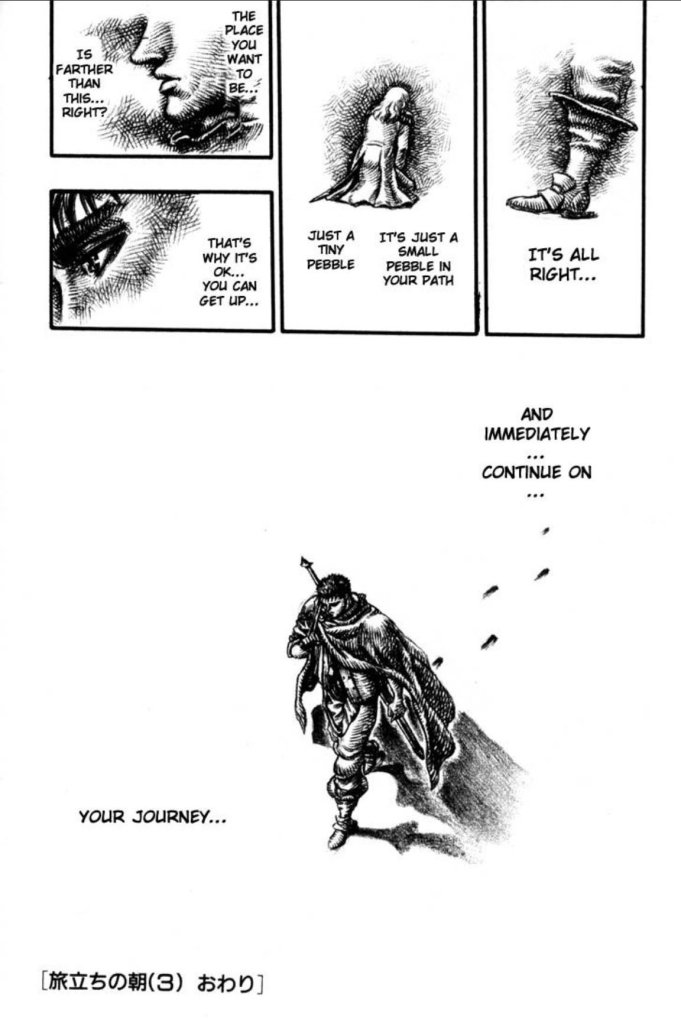
But ultimately, fans won’t remember Berserk‘for all those times it didn’t update or how slow it was to get them. While it’s impact was felt on a wider level through video games, manga, and even heavy metal bands, Berserk is a manga whose themes, characters, and stories have changed the lives of thousands around the world, and have taught them many lessons along the way. It may be known as a manga with emphasis on violence and other heavy subject matters, but it will always be remembered as a manga that taught us that there is always a glimmer of hope as long as we have the will to carry onwards towards a brighter future. When I bought the Official Berserk Guidebook back in 2018, Miura’s many comments throughout and final interview made a lasting impression on my wordview as a Berserk fan and as an artist – he was a man who, even after decades of work, held on to his passion for his greatest work and the medium of art as a whole, and who encouraged others to pursue those passions as well, even it was difficult at times. That is the lesson we should all take to heart.

Thank you Kentaro Miura.
Creator Spotlight: Keiko Takemiya

Screen Shot 2018-08-06 at 8.37.32 AM.png

If you’re a part of the anime community, or if you’ve stayed on the internet for long enough, then chances are that you are somewhat familiar with a certain genre of anime and manga: ‘shounen ai’. Shounen ai, which translates to ‘boys love’ (often shortened to BL), is a genre that focuses on, well, relationships between boys. In this day and age, with an ever-growing acceptance of the LGBT community, manga artists and authors alike have begun to portray same-sex relationships more than ever before. However, in the midst of the constantly-updated library of BL manga, many have forgotten the name of the woman who pioneered it all.

Keiko Takemiya, born February 13, 1950, published her first manga, Ringo no Tsumi, in 1968, when she was just 28 years old. However, it was her next manga that would put her in the spotlight. In the Sunroom, a short story published in December 1970, is widely considered the first shounen-ai, and contains the earliest male-to-male kiss in manga. After the publication of her next manga in 1972, Sora ga Suki!, she travelled to Europe and became inspired, and began traveling there on an annual basis. In addition, a certain country in Europe would serve as the setting of a two her most popular manga.

In October 1976, she released a short story called Natsu e no Tobira, which was first published in the 19th and 20th issue of the Hana to Yume magazine, follows the life of Marion, an adolescent boy who values a philosophy called “rationalism” more than anything else, and starts a group with three other boys (Claude, Lind, and Jacques) at his French boarding school, who all aim to follow his line of thinking. But when Marion becomes entangled in a romantic affair with Sara, an older woman, he begins to wonder if his rationality is just a cover for his own emotional immaturity. At the same time, his friends have their own problems: Jacques and Lind are both fighting for the affection of Ledania, the prettiest girl in town, while Claude struggles to comprehend his feelings for Marion. This tragic coming-of-age story was a success, and was adapted into a 60-minute OVA in 1981, featuring an all-star crew, such as composer Kentaro Haneda, writer Masaki Tsuji, and directors Mori Masaki and Toshio Hirata.

52.png.jpg

Then came Kaze to Ki no Uta. It was published in 17 volumes, from 1976 to 1984, in the magazine Shoujo Comic, and is considered one of her best works. Set in Laconblade Academy, a French boarding school (again) in the year 1880, the story follows Serge Battour, a kind and musically-gifted transfer student, who has to share a room with Gilbert Cocteau, a very mysterious, promiscuous, and highly troubled boy who seems to be hated by every student in the academy. Although Serge doesn’t quite understand Gilbert, he makes it his goal to try and help him,  even though Gilbert makes it his goal to try and bring about his downfall. In the end, the two boys will either come closer together or destroy each other. It was one of the first manga to focus on a homosexual relationship between boys and the first to have sex play a major role in the story. This too was adapted into a 60-minute OVA in 1987.  Despite being highly controversial upon release and (infamously) taking nine years to get published due to her refusal to censor any part of it, it won the prestigious Shogakukan Manga award in 1979, and is now regarded as a classic amongst animanga fans.

Keiko didn’t stop there, though. She continued making manga, and went on to create the famous sci-fi manga Toward the Terra from 1977 to 1980, which won the Seiun Award for science fiction manga in 1978, as well as the aforementioned Shogakukan Manga award along with Kaze to. Terra also received anime adaptations, one in 1980 and one more recently in 2007. During her time creating manga, she was also involved with anime and manga productions, most notably serving as a special designer to the theatrical film Crusher Joe, alongside other anime talents such as Akira Toriyama, Katsuhiro Otomo, and Rumiko Takahashi amongst others. Her last manga, Tenma no Ketsuzoko, finished in 2000, and she has since retired from being a mangaka. In 2014, she was rewarded the Medal of Honor with Purple Ribbon by the Ministry of Internal Affairs and Communications of Japan for her contributions to manga.

Nevertheless, she’s still a hard worker! Since 2000, she has taught at Kyoto Seika University’s Faculty of Manga, served as the Dean for the Faculty of Manga from 2008 to 2013, and is the current president of the university. She’s also served as a member of the selection committee for the Osamu Tezuka Cultural Prize, and is a part of the Year 24 Group, a label applied by critics to a nebulous group of female mangaka who are widely considered to have revolutionized manga in the 70s and 80s.

It’s safe to say that Keiko definitely earned all her achievements, awards, and recognition. Her works have left a lasting impact on many, and there is no doubt that the legacy of the woman who revolutionized and paved the way for same-sex manga will live on.